
Some conversations require more than awareness. They require trust. And for our community, trust has a history.
Pull up a chair. Actually, pull up a few. One for Big Mama, one for Granddaddy, one for the auntie who somehow knows everybody's business but will take yours to the grave, and another for the cousin who keeps everybody laughing. Make room for the uncle who doesn't say much, too. And whatever we do, let's not forget the children.
If we're going to have an honest conversation about mental health in our community, everybody deserves a seat on this porch. Our elders, our parents, our young people, and those who are still finding their way. Because the way we understand mental health today has been shaped by generations of experiences, beliefs, and traditions. Some have strengthened us, while others have left us with wounds we are still learning how to address.
And perhaps that's where this conversation should begin.
We Learned How to Survive
There is something extraordinary about the resilience of Black people in America. Our ancestors endured enslavement, the separation of families, lynchings, Jim Crow, segregation, discrimination, and generations of being denied opportunities and basic human dignity. Even in the face of these injustices, they found ways to build families, establish communities, preserve traditions, practice their faith, and create opportunities for those who would come after them.
That resilience is part of our inheritance, and it deserves to be honored. But we also have to acknowledge that survival often required people to suppress their own emotional needs.
For generations, many of us were taught to keep moving regardless of what we were carrying. You went to work, took care of your family, attended church, prayed about your troubles, and handled your responsibilities. Whatever happened at home stayed at home, and whatever you were feeling was often something you were expected to work through privately.
There was strength in that approach, especially during times when our families had few other options. But there was also a cost. Somewhere along the way, strength and silence became closely connected. Sadness was something to push through, anxiety was dismissed as worrying too much, and depression was sometimes interpreted as a lack of faith. Seeking therapy could invite questions about what was wrong with you, rather than what you might have experienced.
These attitudes didn't develop overnight, and changing them will require more than encouraging people to seek help. We have to understand where they came from.
Our Mistrust Didn't Come From Nowhere
When we discuss mental health in Black communities, we cannot ignore our complicated relationship with the medical system. Asking people to trust institutions without acknowledging the harm those institutions have caused overlooks an important part of our history.
For generations, Black Americans experienced discrimination, exploitation, and mistreatment within American medicine. Enslaved Black women were subjected to medical experimentation, Black bodies were used without consent for medical education and research, and Black patients were often denied the same quality of care afforded to others. Even medical knowledge held by enslaved Africans contributed to Southern medical practices while the people who possessed that knowledge remained in bondage.
The history of psychiatry offers its own troubling examples. In the nineteenth century, a physician named Samuel Cartwright proposed a supposed mental illness called drapetomania to explain why enslaved people attempted to escape. Rather than recognizing the natural human desire for freedom, he treated resistance to enslavement as a disorder.
Think about what that says about the relationship between power, medicine, and the people being treated. When an institution has historically questioned the humanity, intelligence, or experiences of a community, rebuilding trust requires more than simply telling people that things are different now.
This history helps explain why some of our parents and grandparents approached medical institutions with hesitation. Their skepticism wasn't necessarily rooted in ignorance or an unwillingness to accept help. In many cases, it reflected experiences and stories passed down through generations.
Of course, acknowledging this history does not mean rejecting modern medicine or professional mental health care. It means recognizing that trust must be built through respect, understanding, and accountability.
Our community deserves mental health professionals who listen without judgment, recognize the influence of culture and lived experiences, and understand that faith, family, identity, and history can all shape how someone approaches healing.
What Do We Want the Next Generation to Inherit?
Our ancestors gave us so much more than stories of suffering. They passed down faith, music, humor, creativity, traditions, and a deep appreciation for family and community. They taught us how to make something beautiful out of very little and how to show up for one another when life became difficult.
Those traditions remain some of our greatest strengths, and we should never lose sight of their value. At the same time, honoring the generations before us does not mean we have to preserve every belief or coping mechanism exactly as it was handed down.
We can appreciate the sacrifices of our grandparents while recognizing that some of the ways they learned to cope may not serve us today. We can respect the importance of privacy without teaching our children that painful experiences must always remain family secrets. We can value perseverance without expecting people to endure emotional suffering alone. And we can hold tightly to our faith while recognizing that prayer and professional mental health care do not have to compete with one another.
Perhaps one of the greatest gifts we can give the next generation is the freedom to experience emotions without shame.
Today, however, we have an opportunity to do some things differently. We can teach our children how to identify their emotions, communicate their needs, establish healthy boundaries, and seek support when life becomes overwhelming. We can also model those behaviors ourselves, because children learn just as much from what they see us do as from what we tell them.
Our children deserve to inherit our resilience, but they should not have to inherit every silence that came with it.
Healing Begins Between Us
While access to professional resources is essential, changing the conversation around mental health also requires something that cannot be accomplished through a program, campaign, or public service announcement alone. It requires us to examine how we treat one another.
Some of the most meaningful conversations in our community happen in familiar places: around kitchen tables, in barbershops and beauty salons, after church services, at family gatherings, and during quiet moments between friends. These are the spaces where trust already exists, and they can become places where people feel comfortable discussing their emotional well-being.
But creating that kind of environment means being intentional about how we respond when someone opens up.
When a friend admits they're overwhelmed, do we listen, or do we immediately remind them that someone else has it worse? When a man shares that he's struggling emotionally, do we offer support, or do we question his strength? When a mother says she's exhausted, do we recognize that she may need help, or do we expect her to keep carrying everyone else's responsibilities?
And when our children express sadness, frustration, fear, or disappointment, do we make room for those feelings, or do we dismiss them because their problems seem small compared to our own?
These everyday interactions matter more than we sometimes realize. They teach people whether it is safe to be vulnerable and whether asking for help will be met with compassion or criticism.
A safe space is not simply somewhere people are allowed to speak. It is somewhere they trust that they will still be respected, supported, and loved after they do.
Building that trust requires patience, listening without judgment, respecting privacy, and sometimes resisting the urge to offer advice immediately. It also means recognizing when someone may need support beyond what family and friends can provide.
There is tremendous value in having a strong village, but being part of a village does not mean we are expected to have all the answers. Sometimes loving someone means helping them find the resources, counseling, or professional care they need.
We encourage our loved ones to monitor their blood pressure, manage diabetes, eat healthier, and seek medical attention when something doesn't feel right. We should be just as comfortable encouraging one another to care for our mental and emotional well-being.
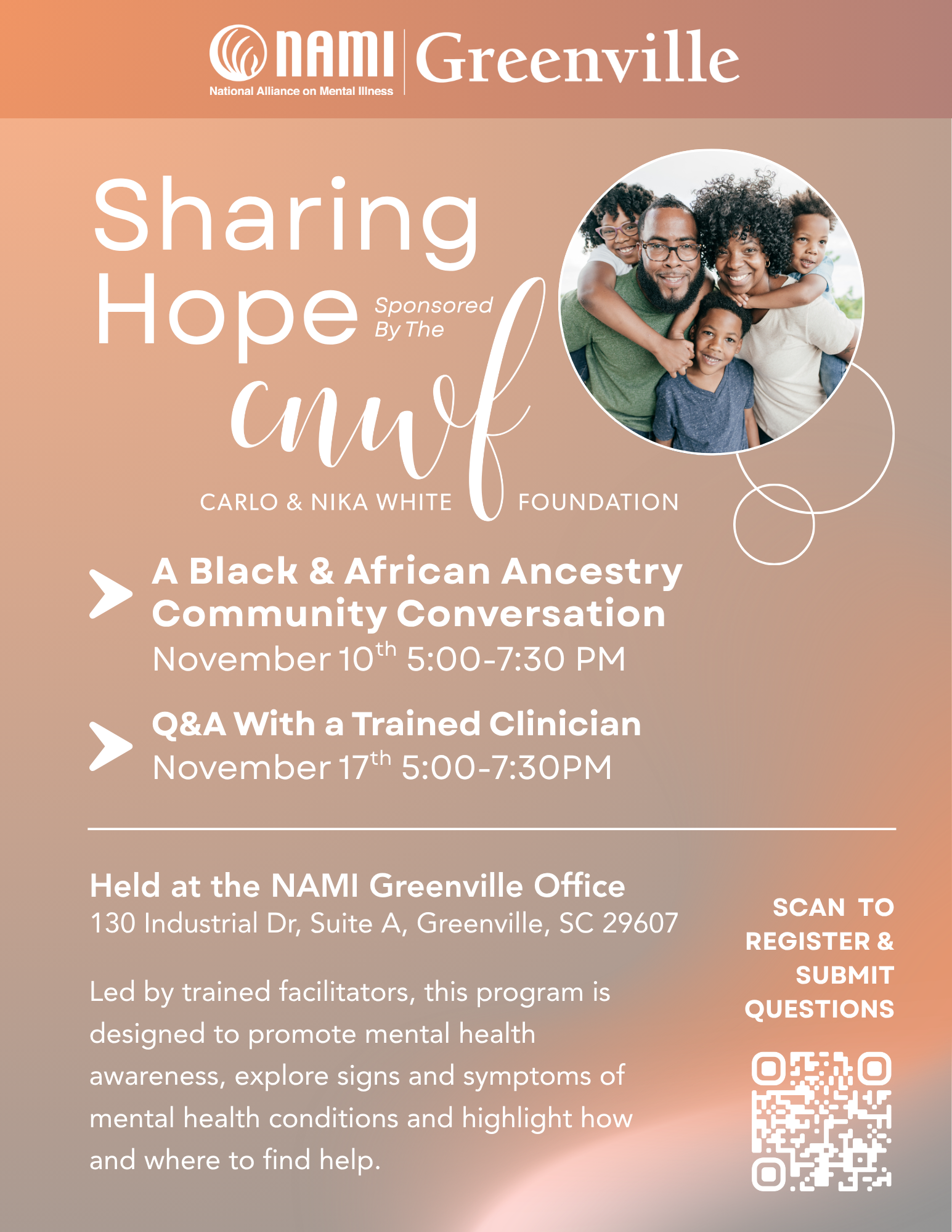
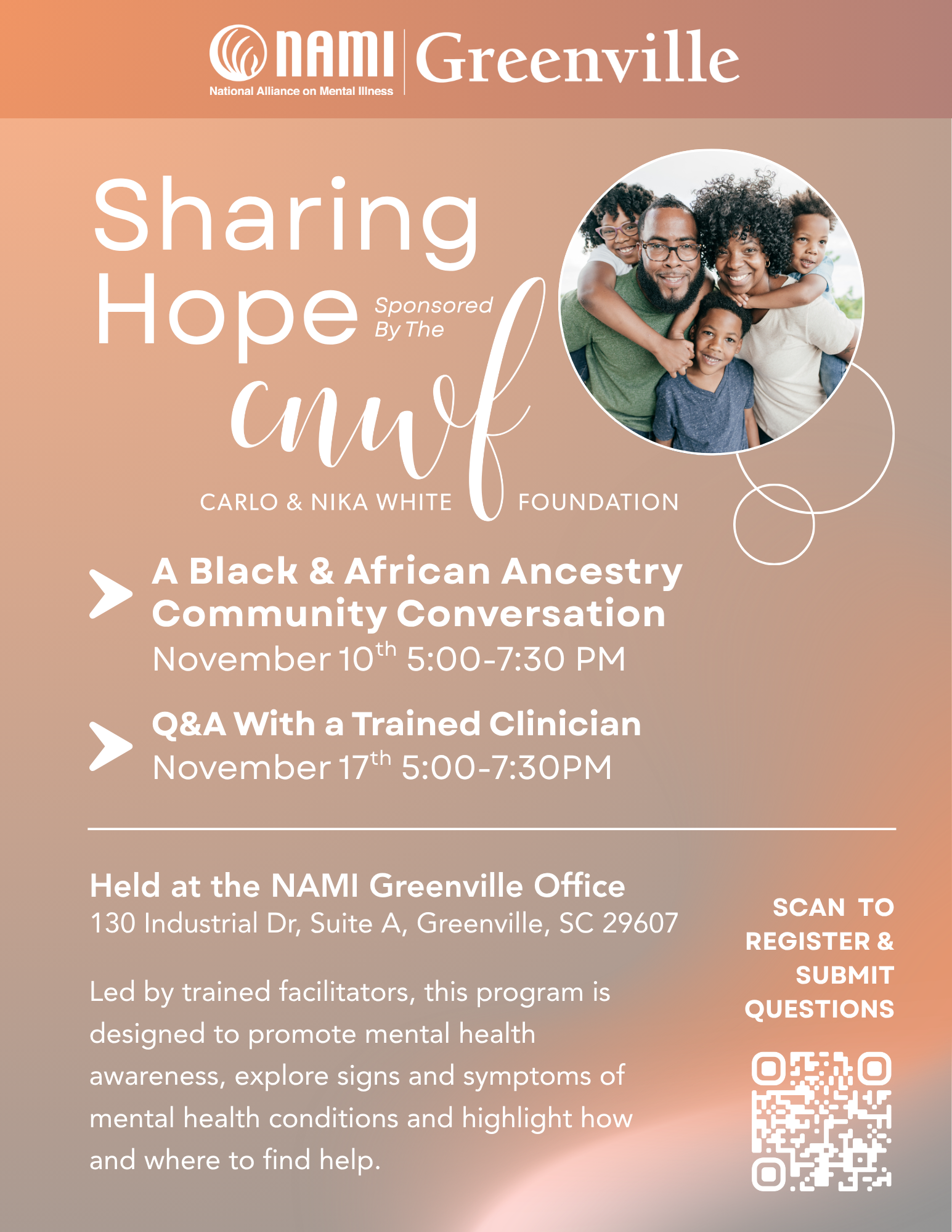
SHARING HOPE
A Mental Wellness Conversation for the Black & African Ancestry Community
Presented in partnership with NAMI Greenville and the Carlo and Nika White Foundation
November 10 & November 17
5:00–7:30 PM
The NAMI Greenville Office
130 Industrial Dr., Suite A, Greenville, SC 29607
Free refreshments will be provided.
Join us for conversation, connection, and community as we work together to make mental wellness something we can talk about—openly, honestly, and among us.
Making Room for the Conversation
This November, the Carlo and Nika White Foundation is proud to partner with NAMI Greenville to sponsor Sharing Hope, a community conversation focused on mental wellness within Black and African ancestry communities. Our hope is that these gatherings feel less like someone standing at the front of a room telling our community what it needs and more like the conversations that happen when people who care about one another come together. We want to acknowledge our history without allowing it to define the limits of our future. We want to create room for questions, including the difficult ones, and recognize that not everyone will arrive with the same experiences or level of trust in mental health services.
Most importantly, we want people to understand that mental health is not an issue affecting some distant group of people. It touches our families, our friendships, our churches, our workplaces, and our neighborhoods.
Leave the Porch Light On
Long before we had the language we use today to discuss mental health, our ancestors understood the importance of community. They knew the value of gathering, sharing meals, telling stories, praying together, and helping neighbors through difficult seasons.
That sense of connection remains one of our greatest resources, and it can play an important role in how we approach mental wellness today.
We don't have to pretend that our history didn't happen, dismiss the concerns of those who are hesitant to seek care, or abandon the traditions that have sustained us. Instead, we can build upon those traditions while making room for new conversations, greater understanding, and additional ways of supporting one another.
Maybe that begins with checking on a friend and being willing to hear an answer other than "I'm fine." Maybe it means having a different conversation with our children than the one we experienced growing up. Or perhaps it means acknowledging that we, too, could benefit from having someone to talk to.
Whatever that first step looks like, we can take it together.
Our children deserve the strength, wisdom, faith, joy, and traditions that have carried our families through generations. But they do not have to inherit every silence, every fear, or every burden that came before them.
We have an opportunity to change what gets passed down, not by forgetting where we've been, but by being intentional about where we go from here.
And that is why we keep the porch light on.
For the people who are ready to talk, for those who are still learning to trust, and for those who may not yet have the words to describe what they're carrying.
There's room for all of us here.