
Some conversations require more than awareness. They require trust. And for our community, trust has a history.
Pull up a chair.
Actually, pull up a few.
One for Big Mama.
One for Granddaddy.
One for the auntie who somehow knows everybody's business but will take yours to the grave.
One for the cousin who makes everybody laugh.
One for the uncle who doesn't say much at all.
And leave some room for the children.
Because if we're going to talk about mental health in our community, everybody needs to be on this porch.
The ones who came before us.
The ones sitting beside us.
And especially the ones coming after us.
Because this conversation didn't begin with us.
And it cannot end here either.
WE LEARNED HOW TO SURVIVE
There is something extraordinary about the survival of Black people in America.
Our ancestors survived enslavement.
Families being separated.
Bodies being bought and sold.
Jim Crow.
Lynchings.
Segregation.
Discriminatory laws.
Neighborhoods denied investment.
Schools denied resources.
Jobs denied opportunity.
And generations of being expected to carry burdens that were never ours to begin with.
We survived.
But sometimes survival required us to learn how to keep moving while hurting.
You worked.
You prayed.
You took care of your family.
You went to church.
You handled your business.
You kept what happened in the family in the family.
And you kept going.
There is strength in that.
There is also a cost.
Because somewhere along the way, many of us inherited the idea that being strong meant being silent.
That sadness was something to push through.
That anxiety was simply worrying too much.
That depression meant you needed to pray harder.
That therapy was for people who were "crazy."
That seeing a psychiatrist meant something must really be wrong with you.
And even today, someone can quietly say, "I've been seeing a therapist," and the room can change.
A therapist?
For what?
What's wrong?
But maybe the better question is:
What happened?
Or even:
How are you—really?
OUR MISTRUST DIDN'T COME FROM NOWHERE
We also have to be honest about something else.
Asking Black communities to trust medical institutions without acknowledging our history with those institutions asks us to forget too much.
Medicine has not always been a safe place for us.
Black bodies helped advance American medicine while Black people themselves were often denied dignity within it.
Enslaved Black women were subjected to medical experimentation.
The bodies of Black people were used for medical education and research.
Medical knowledge carried by enslaved Africans—including knowledge of healing and medicinal plants—became part of Southern medical practice even while the people carrying that knowledge remained enslaved.
And psychiatry has its own history to reckon with.
There was once a supposed mental illness created to explain why an enslaved person would want to escape bondage.
Imagine that.
A human being desires freedom—and rather than questioning the cruelty of the system holding them captive, the system questions the mind of the person trying to become free.
So when someone asks:
Why don't we trust the system?
Maybe we shouldn't answer too quickly.
Maybe Grandmama's hesitation came from somewhere.
Maybe the skepticism passed around our dinner tables has a history.
Maybe some of what looks like resistance is memory.
That doesn't mean we reject help.
It means trust has to be earned.
It means culturally responsive care matters.
It means being heard matters.
It means representation matters.
And it means our community deserves mental-health resources that understand we don't walk into the room without history.
BUT SURVIVAL CANNOT BE OUR ONLY INHERITANCE
Our ancestors gave us extraordinary tools for survival.
Faith.
Family.
Music.
Humor.
Food.
Storytelling.
Community.
Creativity.
Prayer.
The ability to make something beautiful out of very little.
The instinct to gather.
The understanding that when one person's burden becomes too heavy, somebody else helps carry it.
Those things kept us.
And they still keep us.
But perhaps honoring our ancestors does not mean carrying every coping mechanism exactly as it was handed to us.
Maybe honoring them also means asking:
What can we put down now?
The silence?
The shame?
The belief that asking for help makes us weak?
The idea that the family business must always stay behind closed doors—even when somebody inside those doors is hurting?
Maybe the next generation deserves to inherit our resilience without inheriting all of our unspoken pain.
That is a different kind of generational wealth.
THIS WORK HAS TO HAPPEN BETWEEN US
There are conversations institutions cannot have for us.
There are wounds a flyer cannot heal.
There are stigmas a social-media post cannot undo.
This work has to happen within us.
Between us.
Among us.
At kitchen tables.
In barbershops and beauty salons.
In churches.
Between parents and children.
Between friends.
Between husbands and wives.
Between coaches and players.
Between teachers and students.
Between the elders who remember and the children who are still becoming.
We need spaces where somebody can say:
"I'm tired."
And nobody immediately tells them to toughen up.
Where somebody can say:
"I'm overwhelmed."
And we don't remind them how much worse somebody else has it.
Where a Black man can say:
"I need help."
Without having his strength questioned.
Where a mother can admit:
"I'm not okay."
Without feeling as though that makes her less capable of caring for everyone else.
Where our children learn the words for what they are feeling before they have to become adults trying to untangle emotions they were never taught how to name.
And where therapy can sit alongside prayer.
Where professional help can sit alongside family.
Where medicine can sit alongside community.
Where faith and mental-health care don't have to compete with one another.
Maybe the village was never supposed to mean that we carry everything ourselves.
Maybe the village means knowing when someone needs help carrying it.
WE HAVE TO CREATE THE SAFE SPACE WE DESERVE
A safe space isn't simply somewhere people are allowed to speak.
It is somewhere people believe they will still be loved after they do.
That's different.
It requires listening without immediately fixing.
Asking questions without judgment.
Respecting someone's privacy.
Learning what resources exist.
Understanding that the first therapist may not be the right therapist.
Seeking culturally responsive professionals who understand that race, family, faith, identity, economics, community and history can all walk into the room with us.
And giving ourselves permission to care for our minds with the same intention we give our bodies.
We talk about blood pressure.
We talk about diabetes.
We talk about eating better.
We tell each other to go get that pain checked out.
Our minds deserve care, too.
SO LET'S TALK ABOUT IT
This November, the Carlo and Nika White Foundation is proud to partner with NAMI Greenville to sponsor Sharing Hope, a community conversation created specifically around mental wellness in the Black and African ancestry community.
On November 10 and November 17, from 5:00–7:30 PM, we are making room for conversation, connection and resources.
But we don't want this to feel like another event where somebody stands at the front of the room and tells our community what it needs.
We want it to feel more like this.
A porch.
A gathering.
A conversation.
A place where history is acknowledged.
Where questions are welcome.
Where stigma can be challenged.
Where resources can be shared.
And where nobody has to pretend they have everything figured out.
Because mental health isn't somebody else's conversation.
It's ours.
It belongs to the grandmother who has carried everyone else for decades.
The father trying to be strong for his family.
The teenager figuring out who they are.
The college student who feels pressure to make everybody proud.
The entrepreneur lying awake wondering how they're going to keep everything going.
The child who doesn't yet have words for what they're feeling.
The person grieving quietly.
The one who looks like they have everything together.
And maybe even you.
LEAVE THE PORCH LIGHT ON
Our ancestors taught us something long before we had clinical language for it:
We need one another.
Perhaps that is where we begin.
Not by pretending history didn't happen.
Not by shaming people for being hesitant.
Not by telling someone to "just go to therapy" as though trust can be commanded.
We begin by listening.
Learning.
Creating culturally responsive resources.
Having honest conversations.
Making room.
Checking on one another.
And slowly changing what the next generation inherits from us.
Because our children deserve our strength.
They deserve our stories.
They deserve our faith.
They deserve our joy.
They deserve our traditions.
They deserve our wisdom.
But they do not have to inherit every silence.
Some things can end with us.
Some conversations can begin with us.
And some healing can happen between us.
So pull up a chair.
Bring Mama.
Bring Daddy.
Bring your cousin.
Bring your teenager.
Bring your questions.
Bring your skepticism.
Bring whatever you've been carrying.
There's room for you here.
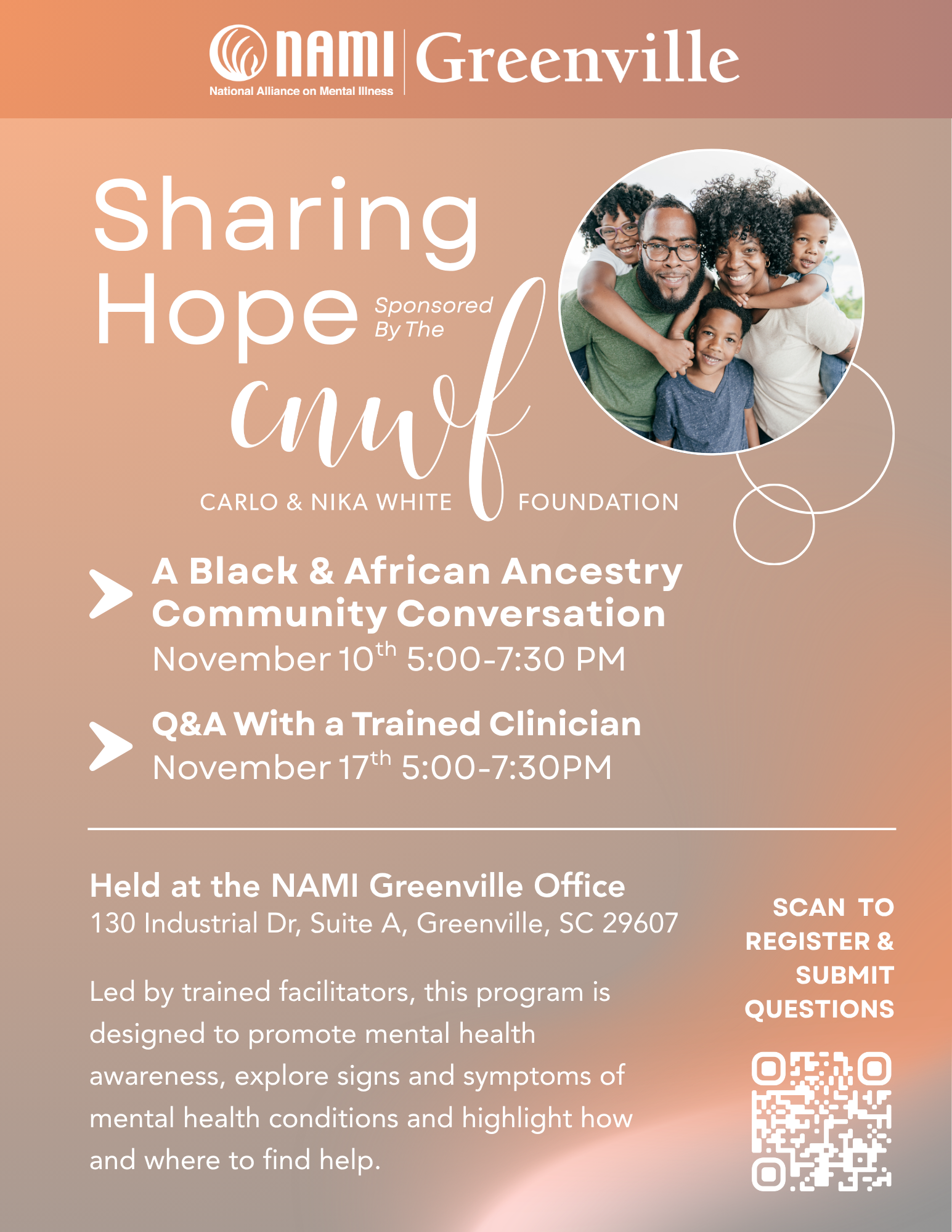
SHARING HOPE
A Mental Wellness Conversation for the Black & African Ancestry Community
Presented in partnership with NAMI Greenville and the Carlo and Nika White Foundation
November 10 & November 17
5:00–7:30 PM
The NAMI Greenville Office
130 Industrial Dr., Suite A, Greenville, SC 29607
Free refreshments will be provided.
Join us for conversation, connection, and community as we work together to make mental wellness something we can talk about—openly, honestly, and among us.